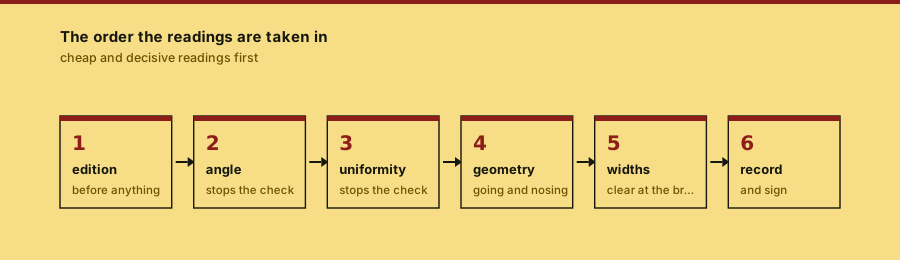
Take the readings in a fixed order and stop as soon as one fails. A flight with a non-uniform riser fails whatever its nosing does, so the uniformity reading comes first and saves the rest of the visit.
How to check a flight against the clause
checked 2026-09-16rots yes — the figures above move with the editionkept by The Nosing Line (a named line, not a person)
Why the order matters
Every clause in the table on this site is an independent requirement. A flight does not accumulate partial credit. Taking the cheap readings first means a flight that cannot pass is identified in two minutes, and the rest of the visit is spent documenting rather than measuring.
The flight sheet
- Establish the edition. Record the document and its year before you take any reading, because every number below belongs to it.
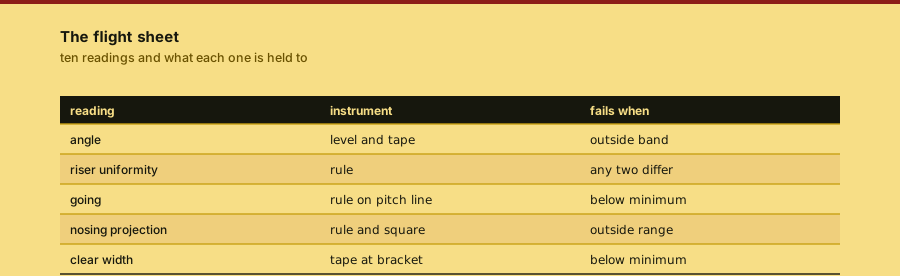
- Measure the total rise and the total going and compute the angle. If the angle is outside the permitted band for the stair type, stop and record.
- Measure every riser in the flight. If any two differ, the flight has failed the uniformity requirement, and that failure outranks everything else on this sheet.
- Measure the going on three treads and the nosing projection on the same three. A going quoted without its projection is ambiguous on a closed stair.
- Test the openings with the sphere for the population the building serves. A 100 mm sphere at a guard, half an inch at a tread surface.
- Check the handrail for continuity along the full flight, including around the inside of a switchback, and for a clear grip on the top and the sides.
- Measure the clear width at the narrowest point, which is normally a handrail bracket rather than the rail itself.
- Measure each landing in the direction of travel and check any door swing that reaches it.
- Test the surface slip reading if a scale is specified, and record which scale it was.
- Write the deviation record and sign it, listing every reading taken and every reading refused.
The two readings that end the check early
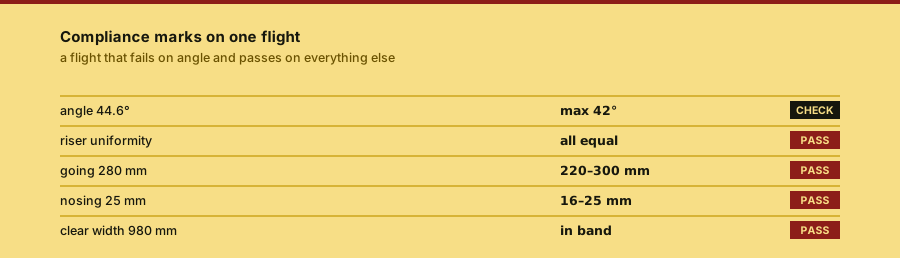
Non-uniform risers end the check. An angle outside the permitted band ends the check. Neither can be cured by a nosing strip, a contrast marking or a handrail, so measuring the rest of the sheet adds nothing to the finding.
A flight that fails on angle can still be a safe stair and a flight that passes on every reading can still be a dangerous one. This sheet records compliance. It does not record safety, and the two are not the same claim.
After the sheet
The findings go into the deviation record with the edition named. A flight that fails under the current edition and passed under the edition it was built to is not a defect; it is a dated observation, and it is the most common finding on this line.
Documents checked
- 1eCFR :: 29 CFR 1926.501 -- Duty to have fall protectionsupports the duty that makes a flight check necessary in the first place
- 2OSHA 3146: Fall Protection in Constructionsupports the construction fall-protection guidance a site flight is checked against
- 3Work Health and Safety (Managing the Risk of Falls at Workplaces Code of Practice) Approval 2020 (ACT Legislation Register)supports a jurisdiction that frames the same check as a risk assessment rather than a table
Each line points at one specific document, with its own title as the link text. No line is a home page and no line is a search result.
File this and go Close this page when the sheet is filled in and signed. An unsigned sheet is a set of measurements, not a check.