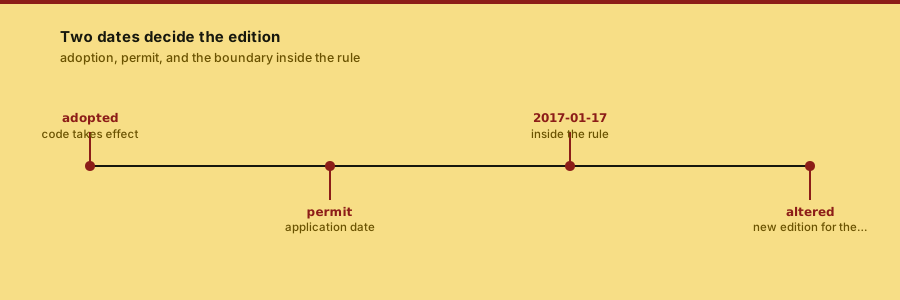
The edition that applies is decided by the adoption date of the code in that jurisdiction and the permit date of the building, not by the edition the designer had on the shelf. Two dates decide it and both have to be found in writing.
How to find which code edition applies
checked 2026-09-16rots yes — the figures above move with the editionkept by The Nosing Line (a named line, not a person)
Why the question is harder than it looks
A code is written nationally and adopted locally, and adoption dates differ between jurisdictions. A building permitted in one state in 2016 and an identical building permitted across a border in 2017 can be held to two different editions of the same document. Neither designer was wrong.
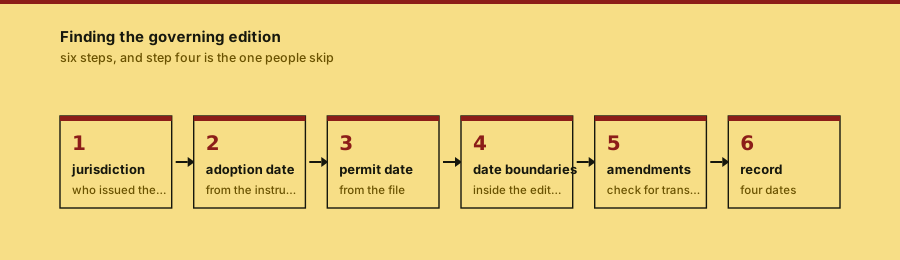
- Identify the jurisdiction that issued the building permit. Not the jurisdiction the designer works in and not the one the head office sits in.
- Find the adoption instrument for that jurisdiction and the date it took effect. This is usually a gazette notice, a regulation or a ministerial order, not the code itself.
- Find the permit application date for the building. Where the building has been altered, find the date of the alteration permit as well, because an alteration can move the stair into a later edition.
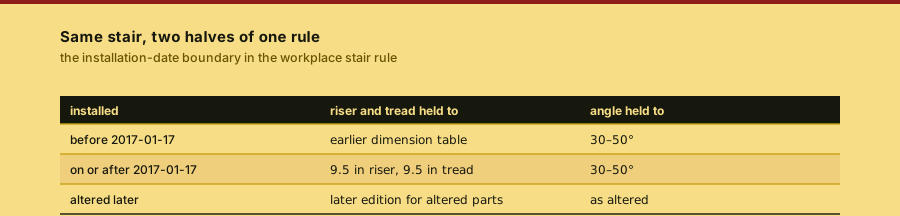
- Look for a date boundary inside the edition itself. The workplace stair rule contains an installation date of 17 January 2017 that splits stairs into two groups with different dimensional requirements.
- Check whether the jurisdiction has published an amendment, a deemed-to-satisfy alternative or a transitional provision. Transitional provisions are common and they routinely allow the earlier edition for a stated period.
- Record the edition, the adoption date, the permit date and the amendment in the deviation record before any measurement is compared against anything.
The two traps
The first trap is using the current edition against an existing building. A stair that fails today's figure may have been built exactly to the figure that applied when it was permitted, and calling that a defect is wrong. The second trap is the reverse: a stair altered last year is held to last year's edition for the altered parts, and to the original edition for the rest, which means one flight can be governed by two documents at once.
The date boundary inside the American workplace rule is the cleanest illustration of the trap. Stairs installed before 17 January 2017 are not held to the riser and tread depth figures at all; they are deemed compliant if they meet the earlier dimension table or achieve the angle range. The same stair measured against the wrong half of that rule produces a finding that cannot be defended.
What to record
Record the four dates and the edition. The measurement that follows belongs to them, and a measurement without them is an opinion about a stair rather than a finding about a building.
Documents checked
- 1Walking-Working Surfaces and Personal Protective Equipment (Fall Protection Systems) -- final rule (Federal Register)supports the publication and effective dates of the current workplace stair rule
- 2Walking-Working Surfaces and Personal Fall Protection Systems -- Final Rule (OSHA)supports the rule-making record that fixes when a stair requirement took effect
- 3O. Reg. 213/91: Construction Projects (Ontario e-Laws)supports a provincial regulation whose date boundaries decide which edition applies
Each line points at one specific document, with its own title as the link text. No line is a home page and no line is a search result.
File this and go Close this page once the four dates are written down. The edition follows from the dates, not from the shelf.